

GARDEN
OUR
learn about:
I love desert gardening.
Now there's four words I never thought would come out of my mouth, and yet, out they come. Particularly when I garden, I've pondered why they do.
I've distilled my thinking down to three reasons that the flora (and fauna) of the desert inspire me so much. I figure this was as good a place as any to share them so below that's exactly what I do and I use them as a way of introducing you to some of my desert favorites.


Adam
Let me first confess that I don't take it all too seriously. I fail as frequently as I succeed. My plants variously survive, die, flourish, struggle, drown and expire, but each time I learn a bit more, get a bit better at it and I have a bunch of chill fun doing it all over again.
Come and enjoy the desert, my home, The Twin Palms Art House, and its gardens and see what you think.
Artfully,
Host/Owner
The Twin Palms Art House
Palm Springs

.jpg)

.jpg)
_JPG.jpg)



Why desert gardens inspire
(including of course the one at The Twin Palms Art House)
1
2
3


Inspiration
1
2
3
The art of endurance
Each cactus and succulent is a masterpiece of survival, turning harsh conditions into striking form


Moroccan Mound
Euphorbia resinifera

Geometric perfection
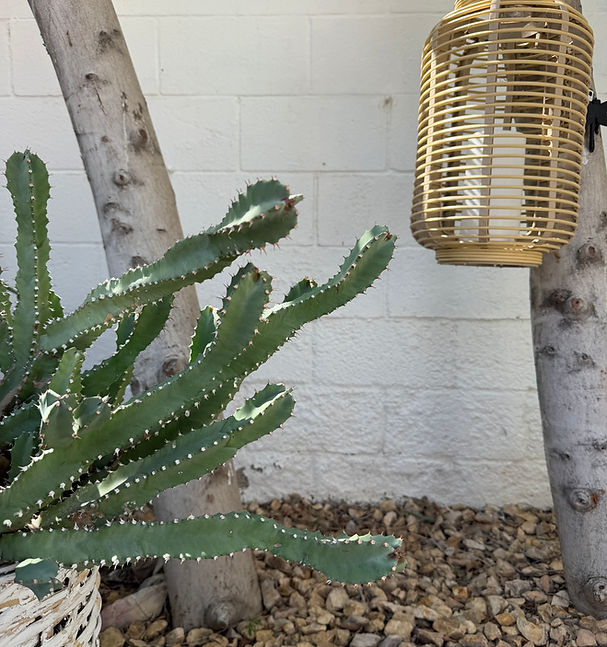
The Moroccan Mound is a study in geometric perfection. It doesn't grow in the wild, sprawling way of other plants; instead, it builds itself into a tight, emerald fortress of uniform columns.
Origin
& History
The Moroccan Mound is basically a living relic. Long before it graced the gardens of Palm Springs, it was prized by the physicians of antiquity.
King Juba II, the monarch of Mauretania (roughly modern-day Morocco and Algeria) and previously the king of Numidia had discovered it growing in the Atlas Mountains.
He named it after his Greek physician, Euphorbus (its scientific name is Euphorbia resinifera). It is often noted that Juba chose the name as a bit of a joke; the plant was fleshy and stout, much like his "well-fed" physician (in Greek, euphorbos translates to "well-fed" or "good fodder").
The Atlas Mountains in North Africa

Medical uses: from poison to modern pharma
King Juba II didn't just name the plant; he wrote a dedicated treatise on its properties, which the Roman scholar Pliny the Elder later cited extensively, making it one of the oldest documented medicinal plants in human civilization. The dried latex, known as Euphorbium, was one of the most famous (and feared) drugs in the ancient world. It appears to have had three main uses - as a purgative, as a topical treatment and as a poison.
First, as a purgative, it was used to induce a "drastic" laxative effect (watch-out!). The reaction it induced was so violent however that it eventually fell out of favor for internal use.
Then it had common topical uses such as after a snakebite, as an eye salve for clearing vision and even "waking sufferers from lethargy" by applying it to the nostrils.
Finally comes its deployment as a potent poison. In this guise it was frequently used on arrow tips due to its highly caustic nature,
in a fascinating modern twist, today the plant is at the center of cutting-edge pain research. It contains resiniferatoxin (RTX), an ultrapotent analog of capsaicin (the heat in chili peppers), however RTX is roughly 1,000 to 10,000 times hotter than capsaicin.
Research is focused on using RTX to "turn off" specific pain-sensing neurons without affecting other sensations like touch or temperature and it's currently being tested for treating intractable pain in advanced cancer and severe osteoarthritis.

How did
you get here?
For each of the plants featured in this Gardens section of our website, one of the obvious questions is how the hell did you end up in a garden in Palm Springs, California? For some the journey waas short and seems almost inevitable, for others, not so much. I would put the Moroccan Mound firmly in the second category.
The Moroccan Mound didn't arrive as a single historic "event" but rather through two distinct waves of botanical interest.
First, in the late 1800s, European botanists and "plant hunters" began exporting Moroccan flora to botanical gardens in the UK and France. From there, cuttings made their way to North America via the U.S. Department of Agriculture and early academic botanical gardens (like those in Philadelphia and New York) where it was initially kept as a "greenhouse curiosity" because of its medicinal fame and its striking, cactus-like appearance.

And today....
It was in the second wave we see this fascinating plant first arrive in our region. From the late 1920s through to the mid-1950s a fascination with Mediterranean and desert landscaping took hold across California.
What drove this? Climate, access and design.
First and probably foremost was a climatic match - the weather across large parts of California lines up with that of the Mediterranean and/or North Africa. Without this, the other forces become irrelevant.
But with this match-up in hand, next came the arrival of wider knowledge of and access to the plant. Most noteably this occured via whats known as The Huntington Collection. Institutions like the Huntington Botanical Gardens in Pasadena (established in 1903) and still very much well worth a visit today were instrumental in importing African and Mediterranean succulents to Southern California. They trialed these plants for the local climate, finding that the arid, frost-free regions—like the Coachella Valley—were perfect matches for the Atlas Mountains.
Lastly comes the match between the plant and the design movement we know as mid-century modernism. By the 1950s, the "clean lines" and geometric structure of Euphorbia resinifera became highly desirable for the burgeoning architectural movement in Palm Springs. Its low-maintenance, sculptural "mound" shape fit the minimalist aesthetic perfectly, transitioning it from a botanical specimen to a staple of California residential design.
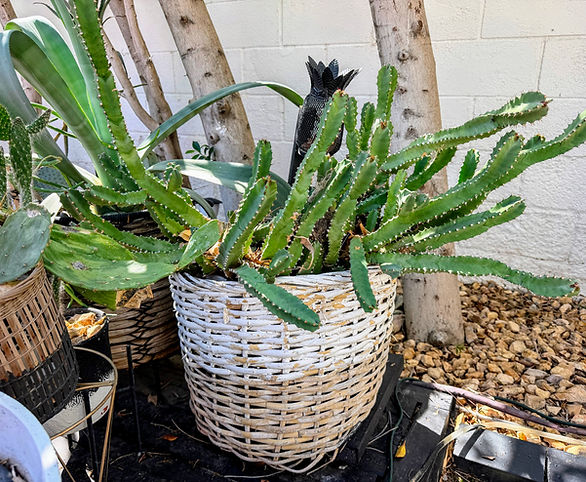
Today, it is considered one of the most reliable and "architectural" groundcovers for desert gardens, and it's thankfully prized more for its blue-green geometry than its ancient, eye-watering laxative properties.
There is a quiet power in its consistency—a dense, lime-green sculpture that proves there is incredible strength in staying grounded and holding your shape, no matter how high the temperature rises.


Spiral cactus
Cereus forbesii ‘Spiralis’
The Shape of Survival
This twisted silhouette is the botanical embodiment of the 'art of endurance'. The Cereus forbesii ‘Spiralis’ does not just grow; it evolves, turning environmental resistance into a sculptural masterpiece.
In the harsh light of the desert, most life seeks to simplify. The Spiral Cactus takes a different path. Its corkscrew form is more than just a visual marvel—it is a testament to the strength found in staying the course. Each specimen is a unique work of art, with ribs that rotate clockwise or counter-clockwise as they mature.

The Spiralis is a botanical anomaly—a rare, naturally occurring mutation that defies the linear logic of the desert. Unlike many ornamental plants engineered in laboratories, this form began as a spontaneous genetic fluke in the wild landscapes of South America.
"Discovered" by Western botanical science only as recently as the late 1970s, this cactus and it's non-twisted counterparts obviously played a prominent role in several indigenous cultures for millennia well before 1970. The catch is that this variant is extremely rare in nature and as a result there is a lack of much documented "ancient" history for the spiral version specifically. In a wild population of thousands of straight-growing Cereus, a single spiral specimen might appear once every few decades. It wouldn't have been a reliable "crop," but rather a botanical "shaman" of the desert—something noticed and perhaps revered, but not widely recorded.
Origin
& History
The northern regions of Argentina are thought to be its most likely location of origin

The stunning glitch
Biologically, the plant is a masterclass in natural geometry. In a standard cactus, cells divide at a uniform rate to create vertical ribs. In the Spiralis, the cells on one side of the rib divide with a slight, persistent lead over the other.
This creates a constant, rhythmic pressure—a literal turning of the plant’s own skin. This is known as a 'somatic mutation'—a rhythmic glitch in the growth tip that caused its ribs to torque as they climbed.

While it can be grown from seed, the spiral is a gift of chance. Some seedlings grow straight, while others wait until they reach a height of 5 to 10 centimeters before the first twist begins to take hold.
Highly resilient to the intense sun, it thrives where other plants falter, standing as a pillar of consistency and a striking guardian of the garden.
This plant represents the perfect intersection of wild biology and mid-century aesthetics. It is a reminder that even in the most rigid environments, nature can produce a beautiful error that proves resilient enough to endure.

How did
you get here?
The transition of the Spiralis from a rare wilderness anomaly to a luxury botanical export and on to thew gardens of Palm Springs began in the early 1970s with the German-Brazilian plant hunter Leopoldo Horst.
While exploring the arid Gran Chaco region of Argentina, Horst discovered a single, massive individual exhibiting a rare "monstrose" spiral mutation. Recognizing the botanical and commercial significance of its unique growth habit, he took cuttings from this original mother plant to ensure the form could be preserved and propagated.
The plant was then first sent to Switzerland to the Su-Ka-Flor nursery operated by Horst’s partner, Werner Uebelmann. Throughout the 1980s, European nurseries worked to stabilize the mutation and build up stock. Because the spiral form is a mutation that does not reliably reproduce via seed, every plant had to be hand-propagated from cuttings. This slow process, combined with the plant's natural pace of growth in a cooler European climate, created a significant supply bottleneck.
During this era, the plant was treated as an elite status symbol for the botanical world. A small six-inch cutting in the early 1980s could fetch between $200 and $500, which equates to roughly $750 to $1,800 today. When these specimens were finally exported from Europe to the United States in the late 1980s and early 1990s, they were marketed as high-end architectural art.
Large, multi-columned plants often commanded prices in the tens of thousands of dollars, reflecting their rarity and the complex international permits required for their transit.

And today....
The shift in the 1990s from small-scale European propagation to larger-scale nursery operations in more compatible climates in Southern California and Israel began to utilize those region's intense heat and sun to accelerate growth rates that were impossible in the greenhouses of Switzerland. This increased production efficiency allowed nurseries to move beyond high-priced individual cuttings and start offering established plants at a price point that made them accessible to landscape designers and homeowners throughout the Coachella Valley.
Highly resilient to the intense sun, the spiralis thrives where other plants falter, standing as a pillar of consistency and a striking guardian of the garden. This plant represents the perfect intersection of wild biology and mid-century aesthetics. It is a reminder that even in the most rigid environments, nature can produce a beautiful error that proves resilient enough to endure.


Inspiration
1
2
3
Shifts in perspective
The garden changes with the light, from the sharp shadows of high noon to the ethereal glow of a moonlit evening.
_edited.jpg)
Giant Agave
Agave americana
_edited.jpg)
The anchor
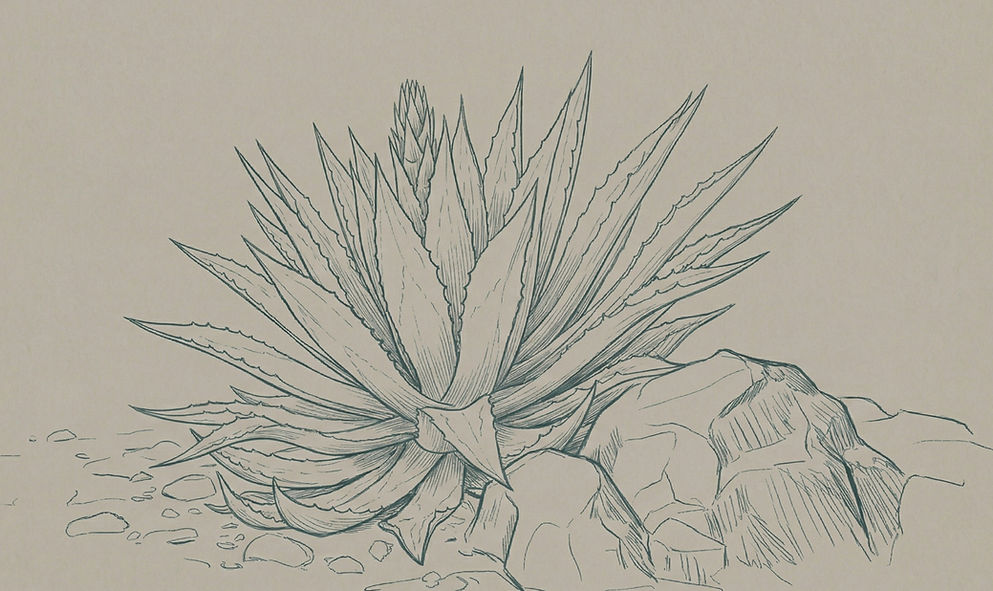
The Giant Agave is the undisputed anchor of the garden, a living sculpture of silver-blue steel. Its massive, arching leaves are edged with teeth and tipped with spines, casting long, dramatic shadows that stretch and shift across the sand as the day wanes.

Origin
& History
Beyond its architectural presence, it carries a storied heritage as the soul of the desert’s most famous spirits. Deep within its heart—the piña—lies the smoky, earthen origin of Mezcal.
These plants are deeply rooted in the high deserts of Mexico, specifically hailing from the states of Tamaulipas, San Luis Potosí, and Nuevo León. For millennia, they were the lifeblood of the Aztec and other Indigenous civilizations. While they have now naturalized from the Mediterranean to Australia, they remain the quintessential symbol of desert grandeur.
The area of northeastern Mexico from which the agave originates

Uniquely designed for scarcity
It is a plant that demands you change your pace; it grows with a slow, deliberate grace over decades, biding its time. This survival is powered by a sophisticated suite of biological adaptations.
Unlike most plants, the agave breathes at night. Through a process called Crassulacean Acid Metabolism (CAM), it opens its pores only under the cool cover of darkness to collect carbon dioxide, preventing the massive water loss that would occur during the blistering heat of the day.

The leaves are intentionally arranged in a perfect rosette, acting as a natural catchment system. Every drop of dew or rare rainfall is channeled down the channeled leaves directly to the plant's core and its shallow, wide-reaching roots.
The "heart" of the agave, or piña, is a massive reservoir of moisture and complex carbohydrates (fructans), allowing the plant to sustain itself through years of extreme drought.

How did
you get here?
Domesticated in Mexico between 7000 BCE and 5000 BCE, the agave served as a vital source of food and fiber for millennia.
Its northern migration into the American Southwest was driven by indigenous groups like the Hohokam, who engineered specialized terraces to farm the plant around 1000 CE. This established a deep botanical corridor across the region long before European arrival.
Following the Spanish conquest in the 16th century, the agave was exported to Europe and naturalized across the Mediterranean after its first recorded flowering in 1561. Spanish missionaries later re-introduced these varieties to California between 1769 and 1833 for use as defensive hedges at their missions.
By the 1850s, nurseries marketed it as a prized exotic, calling it "American aloe" and setting the stage for its eventual architectural prominence.
The final and most locally relevant shift in the plant’s identity occurred between 1945 and 1965, during the rise of desert modernism in Palm Springs. Architects in neighborhoods like Twin Palms recognized that the blue-grey, structural leaves of the agave provided the perfect organic counterpoint to the clean, horizontal lines of post-and-beam construction.
And today....
There is a bittersweet history to this corner of the garden. While you see one magnificent giant today, it was until very recently part of a family of six.
In a rare and synchronized event, five of the six reached the climax of their decades-long journey. This dramatic finale is marked by the emergence of the inflorescence—a massive, terminal flowering stalk that can reach over 10 meters in height.
This "big bang" reproductive strategy is an irreversible commitment; the plant invests every ounce of its stored energy into this single, colossal stalk to ensure its legacy before the parent rosette finally fades. This lone survivor stands as a beautiful, singular reminder of that fleeting legacy, biding its time until it, too, is ready for its final, skyward act (and the hack is there's actually two more just as big but I bet you walked right by them and didn't even notice...).
Rare mass inflorescence of 2025
Add pic of eruption

Inspiration
1
2
3
Intentional beauty
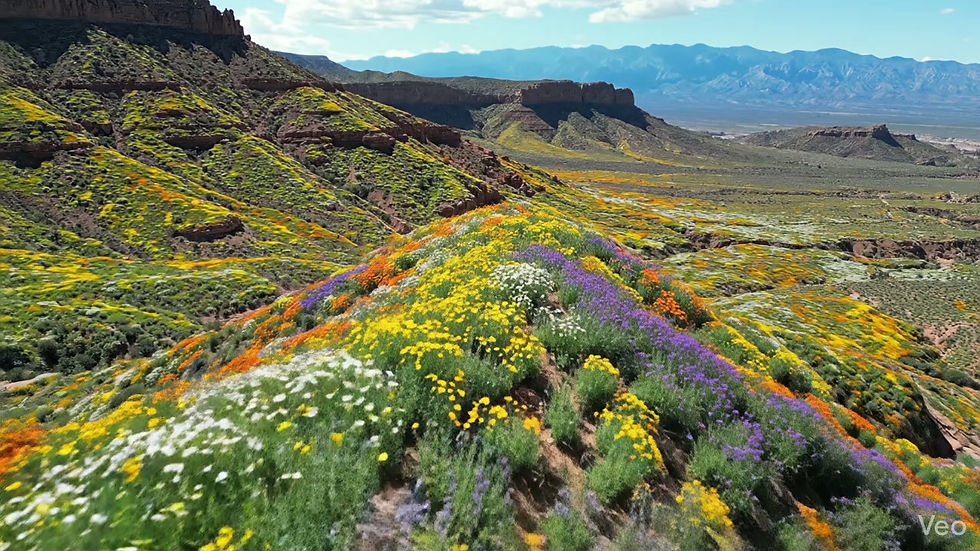
In this environment, every flower is a hard-won triumph and every bloom is a cause for celebration

Argentine Giant
Echinopsis candicans

The
fleeting masterpiece
Audio Coming Soon
For most of the year, the Argentine Giant is a pillar of desert stoicism—a ribbed, thorny sentinel standing firm against the relentless Palm Springs sun. It is a creature of sharp edges and silent endurance. But it guards a secret.

Origin & History
The Monte Desert region in the northwest of Argentina is the original home of the Argentine Giant
Unlike its Mexican neighbors, the Argentine Giant hails from the rain-shadowed deserts of Western and Northern Argentina. It is a signature species of the Monte Desert, thriving in provinces such as Mendoza, San Juan, and La Rioja. In its native habitat, it clings to dry, rocky slopes and high-altitude shrublands of the Andean foothills, where it has evolved to handle both blistering sun and the sharp, freezing nights of the mountains.
The Argentine Giant employs a "strength in numbers" strategy, forming massive, low-growing colonies that can spread up to three meters wide. As a cluster (or by itself), its survival is powered by a series of precise biological adaptations:
First are its water storage stems. Its thick, cylindrical stems are living water tanks, ribbed to allow the plant to expand as it drinks and contract as it depletes its internal reserves during drought.
Then we have the reflective spines which by being dense and a golden-yellow color provide a micro-layer of shade for the green skin of the cactus and reflect intense UV rays, preventing "sunburn" in the open desert.
Lastly is the plants remarkable hardiness in handling cold conditions. Because of its high-altitude origins, it is surprisingly resilient and is capable of surviving short bursts of frost that would kill more tropical cacti.


Desert survival strategies
How did you get here?
Like several other species in the garden the presence of this species in Palm Springs is a result of deliberate botanical selection that coincided with the mid-century modern building boom.
The species was first imported to the Coachella Valley from the Monte Desert as an architectural alternative to the native but much, much slower-growing Saguaro cactus. Landscapers in the 1950s and 1960s favored the Argentine giant for its ability to reach impressive proportions quickly, providing an "instant" desert aesthetic for new estates (it can grow one foot a year versus the Saguaro's average one inch a year!)
Its sprawling, sculptural form and clean geometric lines perfectly mirrored the era’s minimalist architecture, allowing it to become a defining element of the local landscape in neighborhoods like Twin Palms.
Appearing for one night only
Under the cover of a desert moon, a transformation begins. From its rugged spine, impossible silk unfurls. These massive, starlit blooms explode in a silent riot of white and gold, breathing a sweet, heavy fragrance into the midnight air. It is a brief, breathtaking defiance of the harsh terrain.
The flowers are specifically "intended" for the night, using their brilliant white petals to be visible in the moonlight and their intoxicating scent to attract nocturnal pollinators like sphinx and hawk moths.
By noon at the latest, and possibly much sooner in the Palm Springs sun, the petals wilt. It is a fleeting masterpiece, a one-night gift from the desert that demands we stop and notice before the cycle again turns, us with it.


Frangipani
/Plumeria
Plumeria rubra
Audio Coming Soon
_JPG.jpg)
Sculptured resilience
The Plumeria genus, or just Plumeria or as I've always known it in Australia and East Asia, the Frangipani, is truly spiritual to me. In Southeast Asia, where I first consciously let this tree "into my head", the frangipani is far more than an ornamental fixture; it is a living bridge between the physical and spiritual worlds. Known often as the "temple tree," its ivory-and-gold blossoms carpet the courtyards of pagodas and shrines, where their thick, waxy petals symbolize immortality and the quiet endurance of the soul. Oh how I love and miss being a regular visitor to that part of the world.
Planting my own frangipani here in Palm Springs was very much an effort in bridging the geographic and cultural gap between my home and this region of the world that means so much to me. Little did I know this extraordinary plant was far closer to its original home than I was!
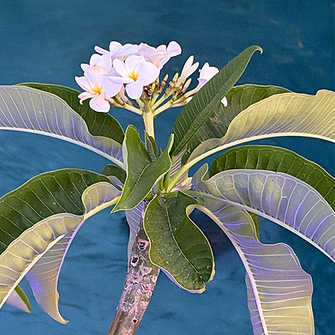
A frangipani cyme opens on our beautiful tree

Origin
& History
It actually originates much closer to Palm Springs than many think to be the case. The tree is actually native to the warm, tropical regions of Mexico (specifically Veracruz and Oaxaca) and to Central America and the Caribbean. Long before it became a staple of tropical gardens worldwide, it was a sacred symbol for the Aztecs, who used its blossoms in medicinal ointments and royal offerings.
The name honors the 17th-century French botanist Charles Plumier, who documented many Neotropical plant species. The name Frangipani actually comes from a 16th-century Italian nobleman, Marquis Muzio Frangipani, who created a popular perfume used to scent gloves; when the flower was later discovered, its fragrance was so similar that the name stuck.
The frangipani rightly rules over the pool yard at
The Twin Palms Art House
_JPG.jpg)
How did
you get here?
The tropical Central and North American origins of the frangipani/plumeria
Spanish explorers eventually carried the tree across the Pacific, where it became so deeply integrated into Hawaiian and Southeast Asian cultures that many mistakenly believe those regions to be its original home. Starting in the 1560s, the Spanish "Manila Galleons" began their regular trade route between Acapulco, Mexico, and the Philippines. Spanish Catholic missionaries were particularly fond of the tree, carrying cuttings from the Mexican coast to the Philippines and eventually into Thailand and Vietnam.

The desert paradox
It seems counterintuitive that a tree synonymous with humid islands could thrive in the arid desert, yet as the amazing specimen that resides by my pool, which I planted as a sapling and which is my true favorite living possession (shhhh, don't tell the cacti!) the Frangipani is a master of adaptation.
Its survival strategy in dry climates is a masterclass in biological efficiency. Its thick, "sausage-like" branches are not just for show; they are specialized water-storage organs just like a succulent. These fleshy stems act as internal reservoirs, allowing the tree to withstand long periods without rainfall.
When the desert temperatures drop or the air becomes too dry, the Frangipani intentionally sheds its large, waxy leaves. This induced deciduous dormancy reduces the surface area for transpiration (water loss), essentially allowing the tree to "sleep" until favorable conditions return.
The leaves themselves also have a thick, leathery cuticle that reflects intense sunlight and locks moisture within the cellular structure.
In the context of intentional beauty, the frangipani is unique because its flowers appear almost as a reward for its survival. Unlike many desert plants that produce small, fleeting blossoms, it produces heavy, architectural clusters known as cymes.
The "intent" is found in the symmetry—five overlapping petals arranged in a perfect spiral, known as a salverform shape. Because the flowers do not produce nectar, they use their incredible, intoxicating fragrance to "trick" sphinx moths into pollinating them at night. This combination of visual perfection and olfactory allure makes it the crown jewel of any intentional garden.
And today....
Our own frangipani tree remains a seemingly very happy resident here at The Twin Palms Art House - I planted it as a one-foot high sapling in 2020 and by early 2026 it had reached at least 20 feet in height and 25 feet in crown diameter. Happy plant indeed.

